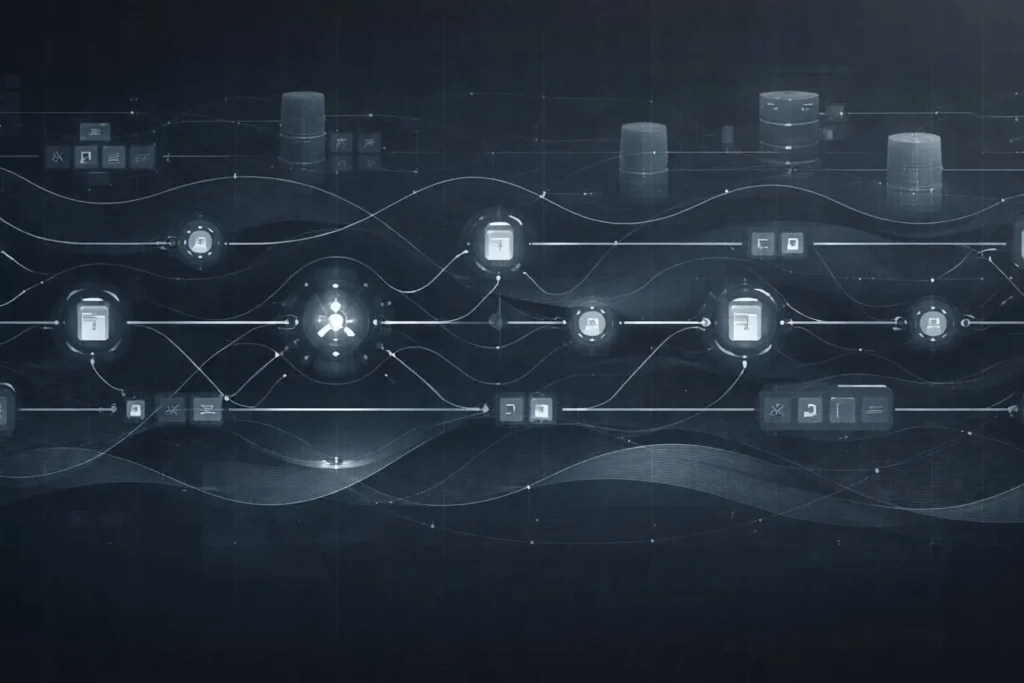
A system-behavior perspective on adaptive workflow orchestration in enterprise systems
Context and System Boundary Definition
Enterprise workflows are undergoing a structural shift in how execution logic is defined, evaluated, and adjusted across modern systems.
Historically, workflows operated through deterministic models where predefined rules governed task sequencing and decision pathways. These systems prioritized stability, predictability, and operational consistency within controlled environments.
However, these architectures assumed that inputs, conditions, and operational contexts would remain relatively stable.
This assumption is increasingly misaligned with modern enterprise environments.
By 2026, workflows operate within systems characterized by real-time data streams, distributed infrastructure, and continuous variability. Under these conditions, rigid workflow logic introduces friction rather than efficiency.
As a result, enterprise workflows are transitioning toward context-aware execution models, where system behavior adapts dynamically within defined governance boundaries.
Editorial Intent Notice
This article examines structural changes in enterprise workflow design and orchestration. It focuses on system-level interpretation and architectural implications rather than product recommendations or implementation guidance.
The objective is to clarify how workflow behavior is evolving within modern enterprise systems.
Why Deterministic Workflow Models Are Becoming Insufficient
Traditional workflow automation relies on predefined rules and linear execution logic.
These models encounter limitations in environments involving:
- Continuous data variability
- Multi-system dependencies
- Real-time operational requirements
- Context-sensitive decision-making
As enterprise systems scale and integrate across platforms, workflows must increasingly respond to conditions that cannot be fully predefined.
This creates the need for adaptive orchestration models capable of evaluating context before executing actions.
Structural Shift in Workflow Behavior
Enterprise workflows are evolving from static execution paths toward dynamic, context-aware systems.
This shift introduces workflows that:
- Evaluate conditions before initiating actions
- Adjust routing based on real-time inputs
- Modify escalation thresholds dynamically
- Integrate feedback loops into execution logic
Rather than following fixed sequences, workflows increasingly operate through adaptive pathways influenced by system state, data context, and operational constraints.
This transition reflects a broader shift in how digital systems interpret context and adapt behavior across environments, as examined in: Global Tech Industry Is Quietly Rewriting How Digital Systems Think in 2026.
The Role of AI in Workflow Orchestration
AI is becoming an embedded component within workflow orchestration layers.
Instead of functioning as an external decision-support tool, AI models now participate directly in execution processes.
This includes:
- Contextual decision scoring
- Dynamic task prioritization
- Predictive routing of workflow steps
- Real-time anomaly detection within execution flows
AI enables workflows to interpret context and adjust behavior while remaining within predefined governance boundaries.
From Automation to Orchestration
The transition from automation to orchestration represents a fundamental change in how workflows are structured.
Automation:
- Executes predefined rules
Orchestration:
- Coordinates system behavior across multiple layers
- Adapts execution pathways based on context
Orchestration introduces a layer where workflows no longer simply execute logic but continuously evaluate system state before determining execution pathways.
This shift reflects a broader movement toward systems that manage complexity rather than enforce rigid control.
This evolution is closely aligned with how enterprise workflows are transitioning toward bounded autonomy, as examined in: From Automation to Autonomy: How Enterprise Workflows Are Being Rewritten by AI (2026).
How Workflow Behavior Is Changing in Practice
In operational environments, these changes manifest as:
- Workflows dynamically adapting to real-time conditions
- Systems rerouting tasks based on contextual inputs
- Reduced reliance on manual intervention for exceptions
- Continuous optimization of execution pathways
These behaviors are often subtle at the interface level but represent significant structural changes within system architecture.
At the same time, the redistribution of execution toward endpoint environments is reshaping how workflows operate across distributed systems, as explored in: The Structural Shift Toward On-Device AI in Enterprise and Consumer Hardware (2026).
Implications for Enterprise Systems
The emergence of AI-orchestrated workflows introduces both advantages and constraints.
Operational Advantages
- Improved responsiveness to dynamic conditions
- Greater alignment with real-world variability
- Reduced friction in cross-system coordination
Structural Challenges
- Increased system complexity
- Reduced transparency in decision pathways
- Higher requirements for governance and auditability
Organizations must balance adaptability with control as workflows become more dynamic.
Limitations and Structural Constraints
Despite these advancements, workflow orchestration remains constrained by:
- Dependence on data quality and availability
- Model interpretability limitations
- Integration complexity across systems
- Governance and compliance requirements
These constraints reinforce the need for structured oversight within adaptive workflow systems.
TECHONOMIX Analyst Perspective
The evolution of enterprise workflows reflects a broader transformation in how digital systems manage complexity.
Workflows are no longer static sequences of tasks. They are becoming adaptive systems that coordinate behavior across multiple layers of infrastructure, data, and decision logic.
This transition does not eliminate control. It redistributes control across system components, embedding intelligence within execution pathways.
As workflows become more context-aware, the distinction between process and system behavior continues to blur.
Understanding this shift is critical for evaluating enterprise resilience, operational flexibility, and long-term system design.
Conclusion
Enterprise workflows are undergoing a structural transition from deterministic automation toward context-aware orchestration.
This shift reflects the increasing complexity of modern enterprise environments and the need for systems that can adapt within defined constraints.
Rather than replacing traditional automation, AI-orchestrated workflows extend it — enabling systems to respond intelligently to changing conditions while maintaining governance and control.
This evolution will continue to shape enterprise architecture, operational models, and system design strategies in the coming years.
About TECHONOMIX
TECHONOMIX is an independent, analyst-driven publication focused on system-level risk, enterprise infrastructure, digital governance, and long-term technology architecture shifts.
Our editorial approach prioritizes structural analysis over hype, examining how emerging technologies reshape operational systems, vendor dependency patterns, and enterprise ecosystem dynamics.